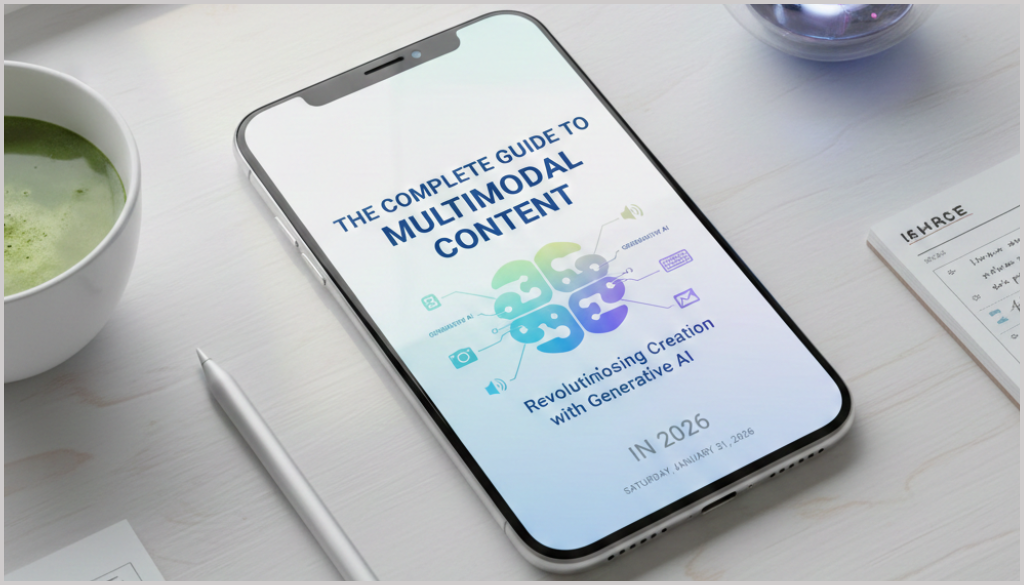
The Complete Guide to Multimodal Content: Revolutionizing Creation with Generative AI in 2026
Visit > PORTFOLIO of Digital Marketing Strategist & Content Creation with Generative AI
The Era of Multimodal Content: A Deep Dive into Generative AI Mastery
In the rapidly shifting landscape of 2026, the way we consume information has fundamentally changed. We no longer just “read” the web; we experience it. This shift is driven by the rise of Multimodal Content, a sophisticated approach to digital storytelling that merges text, visuals, and sound into a seamless, interactive experience. For creators, marketers, and business owners, understanding Multimodal Content isn’t just an advantage—it’s a necessity for survival in a saturated attention economy.
What is Multimodal Content?
At its core, Multimodal Content refers to digital assets that utilize multiple “modes” of communication—such as written word, static imagery, moving video, and synthesized audio—to convey a single, cohesive message. While traditional content might rely on a single medium (like a 2,000-word blog post), Multimodal Content breaks those boundaries. It allows a user to read a summary, watch a generated clip, and listen to a narrated version of the same information, all within one interface.
The Science of Engagement
The reason Multimodal Content works so well is rooted in cognitive load theory. By engaging multiple senses, you increase the likelihood of information retention. Research in 2025 and 2026 shows that users are 66% more likely to prefer platforms that offer varied content formats over those that are text-heavy.
The Pillars of Multimodal Strategy
To build a successful strategy, you must master the three secondary pillars of the modern AI toolkit: text-to-video, AI-images, and audio cloning.
1. The Visual Revolution: AI-images
Long gone are the days of scouring stock photo sites for generic office handshakes. With AI-images, creators can generate hyper-specific, brand-aligned visuals from simple natural language prompts.
- Consistency: Tools like Midjourney v7 and Stable Diffusion 3.5 now allow for “character consistency,” ensuring your brand mascot looks the same across 100 different AI-images.
- Speed: What used to take a graphic designer three days can now be prototyped in thirty seconds.
- Cost-Efficiency: Small businesses can now produce high-end editorial photography using AI-images without hiring a studio.
2. Moving Pictures: Text-to-video
Perhaps the most “magic” element of the 2026 toolkit is text-to-video. We have moved past the era of jittery, uncanny animations. Modern text-to-video models like OpenAI’s Sora and Google’s Veo 2 can create cinematic-quality clips from a single paragraph of text.
- Pro Tip: Use text-to-video to turn your high-performing blog headers into 15-second social media teasers. This “repurposing” is the secret to scaling Multimodal Content without burning out.
3. The Human Touch: Audio Cloning
The final piece of the puzzle is sound. Audio cloning has evolved into a tool for accessibility and personalization. By using audio cloning, a creator can “record” a 30-minute podcast in their own voice simply by uploading a script.
- Localization: Audio cloning allows you to translate your content into 40+ languages while maintaining your unique vocal timbre and emotion.
- Convenience: Don’t have a professional mic setup today? No problem. Audio cloning creates a studio-quality output from a text file.
How to Implement Multimodal Content in Your Workflow
Creating Multimodal Content doesn’t mean you have to work four times as hard. It means you have to work smarter using Generative AI. Here is a step-by-step framework for a modern content loop:
Step 1: The Core Text (The “Anchor”)
Every great piece of Multimodal Content starts with a strong script or article. This is your “Source of Truth.”
Step 2: Generating Visuals
Take key concepts from your text and feed them into a generator to create AI-images. These should act as “visual anchors” for your readers. For example, if you are writing about “The Future of Remote Work,” generate AI-images of futuristic home offices that match your brand’s color palette.
Step 3: Breathing Life into Motion
Identify the “Aha!” moments in your article. Use text-to-video to create short, 10-second background loops or explainer animations for these sections. Text-to-video helps in breaking up long walls of text, keeping the reader’s “scroll-depth” high.
Step 4: Adding the Voice
Finally, use audio cloning to provide an “audio-on-demand” version of your post. This caters to the “commuter audience” who might want to consume your Multimodal Content while driving or exercising.
Why Multimodal Content is the SEO Goldmine of 2026
Google and other search engines have moved toward “Multimodal Search.” This means they don’t just index your words; they index your AI-images, your text-to-video metadata, and your audio transcripts.
- Lower Bounce Rates: Users stay longer when they can switch between reading and watching.
- Rich Snippets: Multimodal Content is more likely to appear in “AI Overviews” and visual search results.
- Backlink Magnet: High-quality AI-images and unique text-to-video clips are highly shareable, earning you organic links from other sites.
To see these strategies in action, feel free to explore my Portfolio Website where I showcase how I integrate text-to-video, AI-images, and audio cloning into live client projects.
Ethical Considerations and The “Human-in-the-Loop”
As we lean into Multimodal Content, we must address the “uncanny valley.” While audio cloning and text-to-video are powerful, they require a human touch to ensure empathy and accuracy.
- Transparency: Always disclose when you are using AI-images or audio cloning. Trust is the currency of 2026.
- Quality Control: AI can hallucinate. Always fact-check the scripts generated for your text-to-video outputs.
- Originality: Use AI to enhance your ideas, not replace them. The heart of Multimodal Content should still be a human perspective.
The Future is Multimodal
The transition to Multimodal Content is not just a trend; it’s the evolution of human communication. By leveraging text-to-video, AI-images, and audio cloning, you can create a 360-degree brand experience that resonates on a deeper level than text ever could alone.
The tools are at your fingertips. The question is: are you ready to stop writing and start building experiences?
Need an Generative AI Content Creator – Visit > PORTFOLIO of Digital Marketing Strategist & Content Creation with Generative AI

Anfasa Rahiman
Anfasa Rahiman
Digital Marketing Strategist | Content Creation with generative AI
Anfasa is an MBA-backed Digital Marketing Strategist in Kannur blending data-driven strategy with cinematic storytelling. She specializes in high-impact videography and design to elevate brands through creative digital excellence.