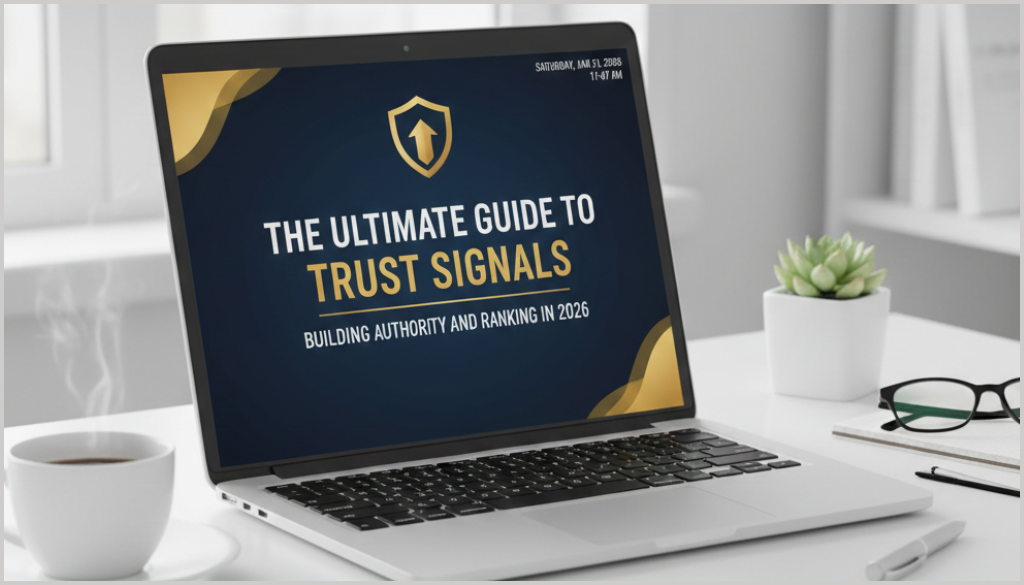
The Ultimate Guide to Trust Signals: Building Authority and Ranking in 2026
In the rapidly shifting landscape of search engine optimization, the metrics of success have moved far beyond simple keyword density and backlink volume. As we navigate through 2026, the most critical element of a successful digital strategy is the Trust Signal. Whether you are a solo creator or a global enterprise, search engines like Google now prioritize the “human” element of your website—how much a user can actually trust the information you provide.
VISIT > Digital Marketing Strategist-Portfolio
What is a Trust Signal in SEO?
A Trust Signal is any element on your website, or across the broader web, that confirms your legitimacy, safety, and expertise to both users and search engine algorithms. In an era where AI-generated content is everywhere, a verifiable Trust Signal acts as a beacon of authenticity. These signals reduce the “bounce rate” by reassuring visitors that your business is real, your data is secure, and your advice is expert-led.
When search engines crawl your site, they aren’t just looking for words; they are looking for reasons to recommend you. By optimizing every Trust Signal on your domain, you tell the algorithm that your site is a safe destination for searchers. This is where the concept of EEAT (Experience, Expertise, Authoritativeness, and Trustworthiness) becomes the backbone of your strategy.
The Pillars of Modern Search: EEAT
Google’s Search Quality Rater Guidelines have made it clear: EEAT is no longer a suggestion; it is a requirement for high-ranking content.
- Experience: Does the author have first-hand, real-world experience with the topic?
- Expertise: Does the creator have the formal credentials or deep-seated knowledge to speak on the subject?
- Authoritativeness: Is the website a “go-to” source in its niche?
- Trust: This is the most important member of the EEAT family. It encompasses the security of your site and the honesty of your claims.
Every single Trust Signal you implement should serve one of these four pillars. If you want to see how these principles are applied to real-world projects, you can explore the [suspicious link removed] to see how I integrate these strategies for my clients.
Why Social Proof is Your Best Salesperson
In 2026, your brand is not what you say it is; it’s what your customers say it is. This is the power of social proof. When a potential client lands on your page, they are looking for a Trust Signal that others have successfully walked the path before them.
Social proof comes in many forms:
- Verified Reviews: Integrating Google Reviews or Trustpilot directly onto your landing pages.
- Case Studies: Detailed breakdowns of how you solved a specific problem.
- User-Generated Content: Photos or videos of real people using your products.
- Influencer Endorsements: Recognition from respected figures in your industry.
By showcasing social proof, you create a psychological safety net for the user. This reduces friction in the buyer’s journey and strengthens your overall brand authority.
Building and Maintaining Brand Authority
High-level SEO is about more than just ranking for a single term; it’s about establishing brand authority. This is the cumulative effect of consistently providing value and earning recognition from your peers. To search engines, brand authority is visible through high-quality backlinks, mentions in major media outlets, and a consistent presence across social platforms.
Every time a reputable site links to you, they are sending a powerful Trust Signal to Google. They are essentially “vouching” for your content. Over time, this builds a fortress of brand authority that makes it difficult for competitors to displace you, even if they have more “technical” SEO optimizations.
Technical Trust Signals You Can’t Ignore
While content is king, the technical health of your site provides the foundation for every other Trust Signal. If your site is slow, lacks an SSL certificate (HTTPS), or has broken links, users will leave before they ever see your social proof.
- Security Badges: Displaying SSL certificates and secure payment icons.
- Clear Contact Info: Having a physical address, phone number, and “About Us” page.
- Transparency: Including a clear Privacy Policy and Terms of Service in your footer.
When these elements are combined with a strong EEAT framework, your website becomes a high-converting asset. You can see examples of this technical precision on the [suspicious link removed], where I showcase how to balance design with data-driven trust.
Summary: The Trust-First Framework
To dominate search in 2026, you must view every page through the lens of a Trust Signal. Ask yourself:
- Does this page demonstrate EEAT?
- Have I included enough social proof to convince a skeptic?
- Is my brand authority visible through my citations and links?
The more you invest in the Trust Signal, the more search engines will reward you with visibility. In a digital world where trust is the rarest currency, making it your primary focus is the ultimate competitive advantage.
VISIT > Digital Marketing Strategist-Portfolio

Anfasa Rahiman
Anfasa Rahiman
Digital Marketing Strategist | Content Creation with generative AI
Anfasa is an MBA-backed Digital Marketing Strategist in Kannur blending data-driven strategy with cinematic storytelling. She specializes in high-impact videography and design to elevate brands through creative digital excellence.